
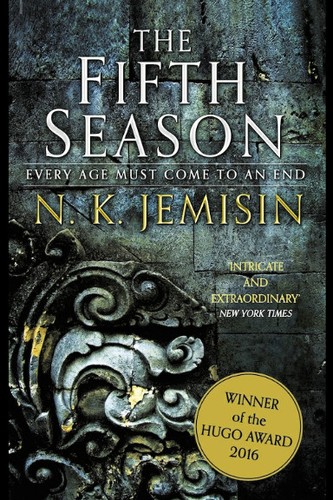
The Fifth Season
Orbit · 2015 · 512 pages
ISBN: 9780316229296
Review Editor
Marcus Webb
There is a moment early in N.K. Jemisin’s The Fifth Season when you understand that the rules of this world are not the rules you assumed. The book opens on catastrophe: a rift splits a continent, ash fills the sky, and a woman named Essun comes home to find that her husband has beaten their young son to death for showing signs of orogeny, the power to sense and control seismic forces. He has also taken their daughter and run. And the world is ending. Essun walks out into it anyway.
Published in 2015 by Orbit Books, The Fifth Season is the first volume in N.K. Jemisin’s Broken Earth trilogy. Jemisin, who spent years writing while working as a counselor and testing psychologist, had already published two completed fantasy trilogies before this one. None of them prepared readers for what she did here. The novel won the Hugo Award for Best Novel in 2016, and then she won again for each of the two sequels. Three consecutive Hugo wins for a single trilogy had never happened before. The books earned that reaction.
The world is called the Stillness, which is a bitter joke. The continent it sits on is geologically violent: it suffers periodic catastrophes called Fifth Seasons, extinction-level events of volcanic winter, sustained earthquakes, and ash clouds that last for years. Human civilization has adapted by building for collapse, storing food obsessively, and identifying and capturing people with orogeny, who can quell tremors and serve the empire. Those people are called orogenes. They are also called roggas, a slur that lands on the page with the weight of every slur that has ever been wielded against a group that society simultaneously fears and exploits. The Fulcrum, located in the imperial capital, trains orogenes from childhood to use their abilities in service of a society that despises them for having those abilities in the first place.
Character Arcs and Development
Jemisin tells her story through three separate narrative threads, following three different women: Essun, a middle-aged orogene living in hiding in a small town; Syenite, a young orogene climbing the ranks of the Fulcrum; and Damaya, a child just removed from her family after her orogeny manifests. Each storyline moves in its own register. Essun’s chapters are written in second person, present tense. You are Essun. You must cross a dying continent to find your daughter. This is not a gimmick; it becomes the book’s moral and emotional anchor.
Essun is the kind of character who shows up in fiction rarely: a middle-aged Black woman whose grief and fury and love are the entire engine of the plot. She has spent years building a careful, hidden life, training herself to pass. The child she searches for, Nassun, has orogeny too. So did the son who was killed. Essun knows exactly what her husband feared, and she is haunted not just by loss but by the specific knowledge that her daughter is walking into a world that will want to use her and hurt her for who she is. Her journey is grief in motion.
Damaya’s storyline follows a child learning to survive the Fulcrum. Her Guardian, a man named Schaffa, is one of the novel’s most carefully constructed characters: he is sincerely kind and profoundly monstrous in equal measure, and Jemisin refuses to resolve that contradiction into something comfortable. Syenite’s storyline places her alongside Alabaster, the Fulcrum’s most powerful orogene, on a mission that takes them to a ruined coastal city hiding an impossible secret. Alabaster is sardonic, brilliant, and carrying something enormous. He is also one of the best mentors in recent fantasy fiction: he tells Syenite things the reader needs to know, but he tells her those things the way a real person with real limits and real pain would.
The revelation of how these three storylines connect is the structural achievement of the book. It arrives gradually, through accumulating details, and when it clicks into place it reframes everything you have read. Jemisin plants the information so carefully that the reveal feels inevitable rather than contrived, and it shifts the emotional stakes in ways that are very hard to recover from.
Pacing
The early chapters ask for patience. Jemisin invents a complete vocabulary for this world: orogenes, stills, comms, use-castes, deadcivs, the Fulcrum, the Guardians. She intersperses chapters of in-world lore, written as textbook entries, that establish the history of Fifth Seasons and survival protocols. This worldbuilding density is purposeful rather than indulgent; the lore chapters carry their own ironies and pay off later. But readers who need immediate narrative momentum may find the opening section slow. Get to chapter five or six and that concern evaporates.
The three-thread structure creates propulsion by design. Each storyline ends chapters at points of tension, and Jemisin switches between them with enough frequency that you carry momentum from one into the next. Essun’s second-person present tense creates a constant low-level urgency, a sense that events are happening now, that you cannot step back. The book’s overall shape is not leisurely. It moves toward its convergence with clear intention, and the final chapters pay off the investment in full.
Deeper Thematic Exploration
Jemisin has been direct in interviews about her intentions. The Stillness is a world that has built its entire civilization on the exploitation and suppression of a group of people who are also the only thing keeping that civilization from geological collapse. Orogenes are necessary and hated. The Fulcrum exists not to protect orogenes but to control them, to harvest their labor, to prevent them from organizing or choosing their own lives. Children are taken from families. Orogenes who run are hunted. Those who comply are still not safe. The novel asks, without softening the question: what does it mean to serve a society that considers your existence a problem to be managed?
This question extends to the structure of the novel itself. The second-person narration for Essun is not just an intimacy device; it is an act of insistence. You will inhabit this woman. You will feel what she feels. Jemisin described it in interviews as a response to fantasy fiction’s historic habit of centering white male protagonists and treating everyone else as secondary. The grammatical choice makes an argument.
The environmental catastrophe backdrop carries its own weight. The Stillness’s people have built survival cultures so deeply ingrained that they have become oppressive in their own right: communities follow strict protocols, non-contributors are cast out, orogenes who cannot control themselves in a crisis are killed. The book understands that crisis conditions do not necessarily make people better. They can calcify existing hierarchies and give new justifications to old cruelties. A world that ends every few centuries develops a particular relationship to hope, and Jemisin is honest about what that relationship looks like.
Motherhood runs through every storyline as its own kind of tectonic force. Damaya is separated from a mother who loved her but also handed her over. Syenite makes choices about becoming a mother that the Fulcrum treats as administrative questions. Essun’s entire narrative is driven by the specific, ferocious love a parent carries for a child in danger. Jemisin does not treat motherhood as warmth or softness; she treats it as something closer to geological pressure, something that builds and does not release.
Style and Voice
The prose is direct and precise, with occasional passages of genuine beauty that arrive without announcement. Jemisin does not write ornately. Her sentences earn their rhythm by doing work. The second-person sections have a quality that is hard to describe: they feel urgent without feeling rushed, intimate without being precious. The third-person sections in Damaya and Syenite’s storylines are warmer, slightly more removed, and that tonal shift itself carries meaning once you understand the structure of the book.
The in-world chapter headings (you are here, you are. Essun) and the textbook excerpts create a kind of polyphony. The world has its own voice, documented and codified, and it often contradicts what the narrative shows you about how the world actually works. That gap between official record and lived experience is one of the book’s quieter arguments.
Verdict
If you read fantasy to escape, The Fifth Season is not that book. If you read fantasy because you want a novel that trusts your intelligence, builds something new, and uses its invented world to say something true about how power works and what survival costs, this is one of the best books written in the genre in decades. Jemisin draws on Octavia Butler’s tradition of science fiction that puts oppression at the center rather than the margins, and she makes it her own. The book is dense at the start and devastating by the end, and the devastation is earned.
You should read it if you are willing to be patient with a slow build and attentive to a novel that rewards rereading. You should probably read all three books in the trilogy; The Fifth Season ends in a way that demands the next volume. If you prefer fantasy that stays within comfortable genre conventions, it will frustrate you. For everyone else: this is the real thing.
Frequently Asked Questions about The Fifth Season
What is The Fifth Season by N.K. Jemisin about?
The Fifth Season is a science fantasy novel set on a geologically violent supercontinent called the Stillness, where catastrophic seasons of climate collapse happen every few centuries. The story follows three women across different time periods: Essun, searching for her daughter after her husband kills their son; Syenite, a young woman navigating an institution that trains and controls people with seismic powers; and Damaya, a child just discovered to have those same powers. All three storylines converge in a way that reframes the entire novel.
What are orogenes in The Fifth Season?
Orogenes are people in Jemisin’s world who have the ability to sense and control seismic energy: they can stop or cause earthquakes, control temperature in their immediate surroundings, and sense geological activity across long distances. Society in the Stillness both needs orogenes, because they help prevent catastrophes, and deeply fears and despises them. The Fulcrum is the empire’s institution for capturing orogene children and training them to serve the state.
What are the main themes in The Fifth Season?
The book centers on systemic oppression: a society that exploits a marginalized group while claiming the arrangement is for everyone’s protection. It also explores motherhood as a source of both vulnerability and fierce purpose, environmental catastrophe and how crisis conditions can harden rather than dissolve injustice, and the personal costs of surviving within systems designed to diminish you. The use of second-person narration is itself a thematic choice about whose interiority readers are required to inhabit.
How long is The Fifth Season and is it a difficult read?
The book runs 512 pages. The difficulty is real but specific: Jemisin builds a fully invented world with its own vocabulary, social structures, and history, and the first few chapters introduce a lot of terminology at once. Readers who push through the first fifty pages find that the concepts settle and the reading becomes fluid. The second-person present-tense narration for the Essun storyline feels unusual at first but most readers adapt quickly. It is not a casual beach read, but it is not impenetrable either.
Did The Fifth Season win the Hugo Award?
Yes. The Fifth Season won the Hugo Award for Best Novel in 2016. N.K. Jemisin then won again in 2017 for the second book in the trilogy, The Obelisk Gate, and again in 2018 for the third, The Stone Sky. She is the first author to win three consecutive Hugo Awards for Best Novel, and the first to win three times for books in the same series.
Is there a movie or TV adaptation of The Fifth Season?
As of 2025, no adaptation of The Fifth Season has been released. Rights to the Broken Earth trilogy were optioned, and there have been various reports of development interest over the years, but no film or television version has reached production. The trilogy’s unconventional narrative structure, particularly the second-person narration, presents genuine challenges for screen adaptation.
How does The Fifth Season compare to other N.K. Jemisin books?
Jemisin published two complete trilogies before the Broken Earth series: the Inheritance Trilogy (beginning with The Hundred Thousand Kingdoms) and the Dreamblood duology. Those earlier books are more conventionally structured and slightly more accessible as starting points. The Fifth Season is widely considered her most ambitious and significant work, with a more formally experimental approach and a more explicitly political focus. Readers who enjoy The Fifth Season often return to her earlier work with renewed appreciation for how her craft developed.
Should I read The Fifth Season and is it worth it?
If you read fantasy and have ever found the genre too comfortable, too safe, or too reluctant to take real risks with form and subject matter, yes. The Fifth Season is the kind of book that expands what you think the genre can do. It is worth reading if you can give it the attention it asks for in its opening chapters. If you pick it up, clear your calendar for the following week, because the second book is right there waiting and you will want it immediately.
Book Details
- Title
- The Fifth Season
- Author
- N.K. Jemisin
- Genre
- Science Fiction
- Publisher
- Orbit
- Year Published
- 2015
- Pages
- 512
- ISBN
- 9780316229296
- WritersReview Rating
- 4.6 / 5