
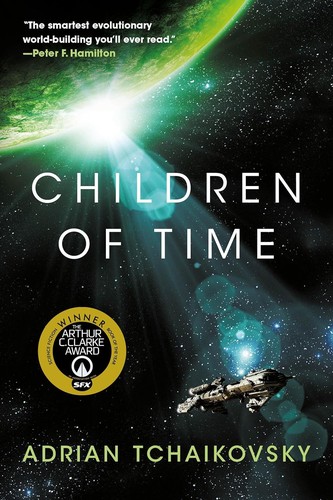
Children of Time
Orbit · 2015 · 640 pages
ISBN: 9780316452502
Review Editor
Marcus Webb
Children of Time, published in 2015 by British author Adrian Tchaikovsky, is one of the most ambitious science fiction novels of the past decade. Winner of the Arthur C. Clarke Award in 2016, it spans thousands of years across two parallel storylines that slowly converge in one of the most philosophically rich conclusions in recent genre fiction. This is not a book that arrives with its best foot forward: it requires patience, investment, and a willingness to spend time with creatures whose minds work almost nothing like yours. If you give it that, it pays back in full.
The novel’s premise is at once simple and staggering. A dying Earth dispatches colony ships to terraform distant exoplanets, seeding them with a nanovirus designed to accelerate the evolution of primates toward intelligence. When one terraforming mission goes catastrophically wrong (a mutiny destroys the seeding vessel), the uplift virus spreads not to monkeys but to the local spider population: jumping spiders of the genus Portia labiata. Over millennia, a civilization of intelligent arachnids grows on the planet now known as Kern’s World, shaped by the orbital remnants of the original mission and an uploaded human consciousness that has been alone in orbit for so long she can no longer quite remember who she was before the upload.
Running parallel to the spider civilization’s rise is the story of the last humans: tens of thousands of survivors in cold sleep aboard the Gilgamesh, a generation ship searching for a livable planet after Earth’s environmental collapse. When their scans identify Kern’s World as viable, the collision between two civilizations that evolved separately across thousands of years becomes inevitable. What follows is not a war story or a first-contact thriller in any conventional sense: it is a meditation on what understanding costs, and whether it is ever possible between minds as different as these.
Character Arcs and Development
The central human characters are Holden, a Classicist historian who believes humanity’s future lies in recovering the lost knowledge of the Old Empire, and Guyen, the Gilgamesh’s increasingly authoritarian captain whose obsession with colonizing Kern’s World curdles into something much darker as the novel progresses. Their conflict runs through the human sections as a study in how desperation corrupts judgment. Holden wants to understand what is on the planet before claiming it; Guyen wants to land, full stop. As Guyen’s control over the ship tightens, Holden’s principled resistance becomes a quiet tragedy about the difficulty of maintaining decency when civilization itself is running out of time. Lain, the ship’s engineer and Holden’s closest ally, provides a needed pragmatic counterweight to scenes that might otherwise tilt into abstraction.
But the spider characters are the ones who stay with you. Tchaikovsky structures the spider chapters through a recurring-name technique: each generation uses the same names within each social role. Portia is always a warrior-hunter, Bianca always a Messenger between cities, Fabian always a male who defies the matriarchal order. This device is one of the novel’s great inventions. You follow a civilization’s evolution through “the same” characters, watching how identity persists and changes across thousands of years. The spiders do not remember their predecessors, but they carry them in biochemical and behavioral inheritance layered in by the uplift nanovirus. Each Portia bears the weight of every Portia before her, not through memory but through accumulated evolutionary pressure.
Fabian is the novel’s most surprising emotional center. In spider society, males are physically small, short-lived, and largely disposable: useful for mating and brief specialized tasks, not much else. The Fabians across the centuries repeatedly challenge this. One develops the chemical compound called Understanding, which allows spiders to share memories and cognitive states directly. Another architects an impossible diplomatic mission despite every social structure working to sideline him. Watching a small, underpowered creature carve out agency inside a civilization designed to overlook him produces a specific kind of satisfaction the novel’s human characters, for all their urgency, cannot match.
Pacing
Tchaikovsky takes on more structural risk than most science fiction authors are willing to attempt, and the pacing reflects that ambition directly. The spider sections build slowly, tracking civilizational change across centuries rather than individual drama across days. A hundred pages might cover five generations and the development of an entire theological institution. Readers accustomed to conventional plot momentum will find this patience-testing, especially in the novel’s middle third, where spider politics and religious disputes can feel abstract. The chapters on the Messenger caste’s theological crisis are thematically essential, but they drag in places.
The human sections move faster, anchored in the immediate urgency of survival and the Gilgamesh’s internal power struggles. This contrast in tempo creates useful tension, but it also means the novel occasionally feels like two different books stitched together. The final hundred pages, when the two civilizations finally make contact, are genuinely exciting in a way the middle section is not. The climb is real. It is worth it. But you should know the climb is there before you start.
Deeper Thematic Exploration
Children of Time is fundamentally a book about what intelligence costs and what it requires. By building a spider civilization from first principles, Tchaikovsky forces the reader to question every assumption about how minds work. The spiders do not just think differently from humans: they think in ways that are genuinely alien. They communicate through chemical signals and threat-displays as much as through sound, experience time through generational rhythms rather than individual lifespans, and have a relationship to death mediated by a recursive, distributed sense of self that human characters simply cannot parse. The book earns its alienness, which is rarer in science fiction than it sounds.
The gender politics embedded in spider biology are the novel’s most provocative thread. Spider society is matriarchal not by ideology but by physics: females are larger, longer-lived, and cognitively faster. Males evolved as specialists for brief, specific tasks. Tchaikovsky uses this to examine what power and gender look like when they run in completely different grooves than they do in human experience. The Fabians’ repeated attempts to carve out agency are more affecting for being structurally constrained rather than merely politically opposed. The book does not offer easy human parallels; the matriarchy is as capable of cruelty and institutional blindness as any patriarchy, which is the point.
The religious strand is equally careful. Spider theology develops from a real phenomenon: the orbital platform above Kern’s World, which communicates occasionally and whose transmissions once saved an entire spider colony from annihilation. The Messenger caste, who maintain the radio contact protocols across centuries, function as both priests and scientists. The novel handles that dual role with real sophistication. When the scientific discoveries made by later Fabians begin threatening the theological framework, the resulting crisis is not treated as crude science-versus-religion allegory. The spiders genuinely grapple with what it means to discover that your god is a frightened, deeply confused woman who has been waiting forty thousand years for monkeys that will never arrive.
Kern herself is one of the novel’s great achievements. Dr. Avrana Kern uploaded her consciousness into the orbital platform to await the primates’ evolution into intelligence. By the time the spiders finally contact her, she has been alone for millennia, held together by a purpose she can no longer fully articulate. Her arc, scattered through the novel in fragments, is a study in how isolation warps even a sophisticated mind that knows it is warping. She cannot admit the spiders are what she was waiting for, because admitting that means admitting the mission failed, and she is all that remains of it.
The colonial dimension of the human-spider conflict is handled without heavy-handedness. The humans’ assumption that Kern’s World belongs to them by virtue of human origin, despite the civilization that evolved there in their absence, echoes historical conquest in ways the book lets you notice without laboring the point. The spiders earned their world through forty thousand years of development. The humans are drowning. Neither claim cancels the other, and the novel refuses to resolve that tension cheaply.
Style and Voice
Tchaikovsky writes with a precision that suits his material. The prose is clear and functional rather than ornate, which is the right choice for a book this concerned with systems, ideas, and long spans of time. He has a particular gift for conveying scientific concepts through behavior rather than exposition: the first time you encounter spiders using the chemical Understanding, you feel the strangeness of it before you understand the mechanism. The occasional passages that tip into infodump are offset by how genuinely interesting the underlying information tends to be.
Point-of-view shifts are handled with care. The spider chapters maintain a consistent third-person distance that prevents easy human identification: you are always slightly outside these minds, always aware they are different from yours. The human chapters allow slightly more interiority, creating a subtle asymmetry that serves the book’s larger argument. You understand the humans better, but you feel the spiders more fully. That inversion is one of Tchaikovsky’s most quietly effective achievements.
Verdict
Children of Time is essential science fiction. It does not do everything perfectly: the middle section tests patience, some human characters are thinner than the spiders they share a novel with, and Tchaikovsky occasionally explains where he should simply show. But the book achieves something rare: a genuinely alien civilization built from first principles, given scientific rigor and emotional intelligence, that earns real feeling from its readers. If you have ever wanted science fiction to do intellectual and emotional work simultaneously, this is a strong place to start. The direct sequels, Children of Ruin and Children of Memory, continue the universe in equally ambitious directions. The trilogy is among the serious achievements of contemporary science fiction, and this first volume is where to begin.
Frequently Asked Questions about Children of Time
What is Children of Time by Adrian Tchaikovsky about?
Children of Time is a science fiction novel following two storylines set thousands of years apart. In one, a civilization of intelligent jumping spiders evolves on a terraformed exoplanet after a botched human experiment sends an uplift virus to the wrong species. In the other, the last remnants of humanity travel on a generation ship searching for a habitable world after Earth’s collapse. The two stories converge when the ship discovers the spider planet and both civilizations must decide whether understanding each other is even possible.
Did Children of Time win any major awards?
Yes. Children of Time won the Arthur C. Clarke Award for Best Novel in 2016, one of the most prestigious awards in British science fiction. It was also shortlisted for the British Science Fiction Association Award for Best Novel. Its sequel, Children of Ruin, won the Clarke Award in 2020, making Tchaikovsky one of the few authors to win that prize with consecutive novels in the same series.
What are the main themes in Children of Time?
The book’s central themes include the nature of intelligence and consciousness, asking whether minds built from entirely different biology can understand each other at all. It examines gender and power through the lens of spider society’s matriarchy, explores religion and science as intertwined rather than opposed forces, and confronts the ethics of colonial entitlement when one civilization claims a world another has already developed. Questions of time, identity, and what persists across thousands of years run through both storylines.
How long is Children of Time and is it a difficult read?
The US edition runs approximately 640 pages. It is not a fast or easy read: the spider civilization chapters build slowly, tracking cultural and evolutionary change across centuries rather than individual drama. Readers who prefer steady narrative momentum may find the middle sections challenging. Readers willing to engage with genuinely alien worldbuilding and big ideas about consciousness will find the payoff significant. The prose itself is clear and accessible; the challenge is structural and conceptual rather than stylistic.
Is Children of Time based on real science?
The novel draws on real spider biology. Portia labiata, the jumping spider species at the center of the book, is genuinely known for problem-solving intelligence and visual acuity unusual among invertebrates. Tchaikovsky researches his material carefully, and the spider civilization’s social structures, chemical communication, and cognitive patterns are extrapolated from real arachnid behavior rather than invented from scratch. The uplift nanovirus is science fiction extrapolation, but grounded in plausible evolutionary biology.
Is there a movie or TV adaptation of Children of Time?
As of 2026, no film or television adaptation of Children of Time has been released. The novel’s structure, alternating between thousands of years of spider civilizational development and a human generation-ship storyline, presents real adaptation challenges. The book’s value lies substantially in internal states and slowly accumulating changes that are difficult to dramatize. Rights have been discussed at various points, but nothing has entered active production.
How does Children of Time compare to Adrian Tchaikovsky’s other books?
Children of Time is widely considered Tchaikovsky’s breakthrough work and the novel that established him as a significant voice in science fiction. His other science fiction includes the direct sequels Children of Ruin and Children of Memory, plus standalone novels like Cage of Souls. His earlier career produced the ten-volume Shadows of the Apt fantasy series. Children of Time represents a step up in ambition and scope from his earlier work, and the sequels maintain that level. If you want to start with his science fiction, this is the right entry point.
Should I read Children of Time if I don’t usually enjoy science fiction?
Possibly, with honest caveats. Children of Time is less concerned with spaceships and action than with evolution, consciousness, and the difficulty of understanding minds unlike your own. Readers who enjoy ambitious, idea-driven literary fiction often respond to it well even without a science fiction background. The slow pacing in the middle sections can deter readers looking for conventional narrative drive. If you are willing to commit to a novel that asks you to think alongside it for a few hundred pages before things accelerate, the experience is substantial and the book will stay with you.
Book Details
- Title
- Children of Time
- Author
- Adrian Tchaikovsky
- Genre
- Science Fiction
- Publisher
- Orbit
- Year Published
- 2015
- Pages
- 640
- ISBN
- 9780316452502
- WritersReview Rating
- 4.5 / 5