
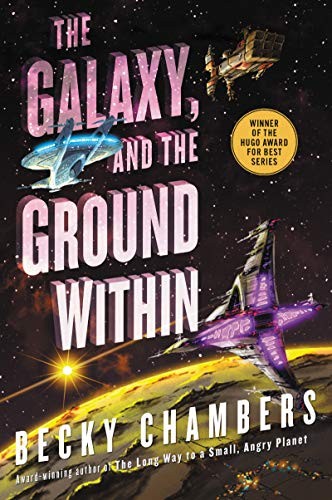
The Galaxy, and the Ground Within
Harper Voyager · 2021 · 335 pages
ISBN: 9780062936042
Review Editor
Marcus Webb
Summary
Five Pebble is an unremarkable planet. It has no particularly interesting geography, no great natural phenomena, nothing to draw visitors except its position at a junction of transit lanes that makes it a convenient waystation for travelers moving between more significant destinations. Ouloo, a Laru innkeeper, has built her life here with her child Tupo, running the Five-Hop One-Stop with the modest ambition of offering good hospitality to whoever needs it. It is not an ambitious life by the standards of the Galactic Commons. It is, Chambers seems to argue, exactly the right kind of life.
When a satellite malfunction grounds all ships in orbit and prevents anyone from leaving, Ouloo finds herself hosting an involuntary reunion: Pei, an Aeluon cargo runner with a complication in her personal life; Speaker, an Akarak mercenary who has never been on the ground and is unused to trusting anyone; Roveg, a Quelin who has been exiled from his home society and is racing toward a reunion that may not wait if the delay is too long; and Gora, a human geologist present more or less by accident.
The Galaxy, and the Ground Within is the fourth and final novel in Becky Chambers’s Wayfarers series, and it completes the series with a story so deliberately small in scope that it takes a paragraph to explain what it is not: not an adventure, not a revelation, not a climax. What it is, instead, is a meditation on what civilization actually consists of when you strip away the machinery of grand events and examine what happens when diverse beings simply have to be together.
Character Arcs and Development
Each of the novel’s five primary characters arrives at the waystation with a story that has mostly already happened. Chambers reveals their histories gradually through conversations made possible by the enforced proximity of stranding, and what she reveals is that each of them carries something: grief, exile, complicated love, the weight of a species’ accumulated trauma, the ordinary anxiety of a child growing up in a universe full of beings unlike them.
Roveg is the novel’s most developed character and its emotional center. His exile from Quelin society, a society with rules so elaborate and penalties so severe that a creative misstep can constitute a crime, is rendered with specific sadness. His complicated relationship to the culture that expelled him is one of the most honest depictions in the Wayfarers series of what it means to love a home that cannot love you back in the way you need.
Speaker is the most conceptually interesting. The Akarak are a species defined by trauma: their homeworld is gone, they live in pairs in spacesuits because their physiology is incompatible with most atmospheres, and their history of mistreatment by other species has produced a culture of profound wariness. Speaker’s gradual, reluctant opening to the other stranded travelers is the novel’s most delicate arc, rendered with Chambers’s characteristic refusal to rush emotional processes or resolve them cleanly.
Ouloo and Tupo provide the grounding domestic perspective. Ouloo’s profession, providing hospitality, is not incidental to the novel’s themes; she is someone who has made her whole life out of the effort to make others comfortable, and the stranded travelers test that vocation in ways both practical and philosophical. Tupo, a Laru child still growing into who they are, provides the perspective of someone for whom all of this is still new and strange.
Pacing
The novel has no conventional plot momentum. Events happen, but they are the events of daily life: meals prepared, conversations had, children minded, small kindnesses extended and received. The resolution of the satellite malfunction is not a climax but an ending: the condition that brought these people together resolves, and they disperse, carrying what they found here. What they found here is the point.
Readers who require forward narrative momentum will find this the most challenging of the Wayfarers novels. Readers who have loved the series for its quality of sustained, attentive presence will find it among the most pleasurable. Chambers is offering something closer to what a long afternoon with good people feels like than what a conventional narrative feels like, and the reader’s experience will depend on whether they are willing to slow down enough to receive it.
Deeper Thematic Exploration
The novel’s central concern is what it means to be a galactic civilization. The Galactic Commons has solved war, scarcity, and most of the structural sources of large-scale suffering. What remains is the question of what civilization is for once those problems are addressed, and what it consists of at the level of daily practice, the thousand small choices that accumulate into culture.
Chambers’s answer is hospitality. Not hospitality as luxury or performance, but as the basic disposition of making room for beings unlike yourself, of extending care before you are required to, of treating the stranger as someone who might become a neighbor. Ouloo embodies this disposition professionally, but the novel suggests it is available to everyone and is, in fact, the foundational practice that makes a galactic civilization actually civilized rather than merely organizationally convenient.
The Akarak subplot introduces a necessary complication: the difficulty of extending hospitality when the would-be guest has been systematically mistreated by the very civilization doing the extending. Speaker’s wariness is not paranoia; it is appropriate historical consciousness. The novel does not pretend that goodwill is sufficient response to accumulated harm, but it does suggest that goodwill, consistently offered, can be the beginning of something.
Style and Voice
Chambers’s prose in this final Wayfarers novel is the most refined version of what she has been developing throughout the series. The sentences are clean without being spare, the descriptions specific without being exhaustive, and the emotional register warm without being sentimental. The dialogue is at its best here: characters talk to each other in ways that reveal rather than explain, and the conversations between species who communicate differently are managed with both practical ingenuity and genuine charm.
The alien species in the Wayfarers series are among the most carefully constructed in recent science fiction. They are not humans in funny costumes, but beings with comprehensible motivations and recognizable, if not identical, emotions. Chambers’s achievement in this final novel is to make a group of very different beings feel like a group in the most ordinary and meaningful sense: a collection of individuals who have spent enough time together to become something more than strangers, and in doing so, to have built between themselves a small piece of the civilization the novel is trying to describe.
Verdict
The Galaxy, and the Ground Within is a quiet, generous, and genuinely moving conclusion to one of the most beloved series in contemporary science fiction. It will not satisfy readers looking for answers to grand questions or resolution of epic conflicts, because it is not that kind of story. It is a story about a few days spent with interesting people on an unremarkable planet, and it argues, through the quality of attention it pays to those days, that such time is not unremarkable at all. It is, in fact, what civilization is made of.
For readers new to the Wayfarers series, this is not the best entry point; The Long Way to a Small Angry Planet remains the ideal beginning. But for anyone who has loved these books, this ending is worth the journey, and it leaves the series in exactly the right place: not with triumph or tragedy, but with ordinary people in an ordinary place doing their best to be kind to each other. This, Chambers insists, is enough. She makes you believe her.
Four stars: not Chambers’s most immediately accessible work, but among her most mature, and a worthy final statement from one of science fiction’s most important contemporary voices.
Do you need to read the other Wayfarers books first?
The novel is designed to stand alone and does not require knowledge of the previous books. That said, readers who come to it after the first three Wayfarers novels will get more from the character connections and the accumulated sense of the Galactic Commons. If you have not read the series, The Long Way to a Small Angry Planet is the ideal starting point.
Is this the last Wayfarers novel?
Yes, Chambers has confirmed that The Galaxy, and the Ground Within completes the Wayfarers series. She continues to write in the Monk and Robot novellas and has indicated interest in new projects. The Wayfarers series is complete in four novels: The Long Way to a Small Angry Planet, A Closed and Common Orbit, Record of a Spaceborn Few, and this final volume.
What is the Galactic Commons?
The Galactic Commons is the interspecies governing body that provides the political and social framework for the Wayfarers series. It is a voluntary union of spacefaring species that has collectively agreed on standards of interspecies relations, trade, and conflict resolution. The series presents it as imperfect but broadly functional, having solved some of the largest categories of suffering while leaving plenty of smaller questions unresolved, which is about the best any civilization can honestly aspire to.
Why is this book set on such an unremarkable planet?
The deliberate ordinariness of Five Pebble is the point. Chambers has described the novel as an argument that the unremarkable is where civilization actually lives. Grand events and heroic settings are the exception; ordinary places where ordinary beings try to be decent to each other are the norm, and she wants to pay attention to the norm with the seriousness it deserves.
What species appear in this book?
The novel features Laru, large furry beings who communicate through gesture and coloration; Aeluon, iridescent beings whose emotional communication is partly chromatic; Akarak, small trauma-marked beings who live in pairs in protective suits; Quelin, exoskeletal beings whose culture is governed by extremely elaborate rules; and humans. All have appeared in previous Wayfarers novels, though the book provides enough context for new readers to understand their basic nature.
Is there any action or conflict in the novel?
There is a minor crisis partway through the novel that provides some urgency, but it is not the focus. The primary conflicts are interpersonal and philosophical: how do you extend trust to someone whose species has reason to distrust yours? How do you stay with people who remind you of what you have lost? How do you keep offering hospitality when hospitality is hard? These are Chambers’s characteristic questions, taken seriously even when they do not produce dramatic action.
What themes does this share with A Psalm for the Wild-Built?
Both books are concerned with what it means to live a good life in a world that has solved the most dramatic categories of suffering. Both ask what remains when scarcity and violence are no longer the primary organizing forces of existence. Both find answers in specific, ordinary connection: in conversation, in shared meals, in the effort to see another being clearly and extend appropriate care. They are companion pieces in theme even though they are set in different universes.
Is this a good introduction to Becky Chambers’s work?
It is not the ideal introduction, primarily because its pleasures are cumulative: they build on familiarity with the series and its characters. A Psalm for the Wild-Built is the better introduction for new readers: shorter, completely standalone, and demonstrating Chambers’s voice in its most concentrated form. The Long Way to a Small Angry Planet is the correct starting point for anyone who wants to read the full Wayfarers series.
Book Details
- Title
- The Galaxy, and the Ground Within
- Author
- Becky Chambers
- Genre
- Science Fiction
- Publisher
- Harper Voyager
- Year Published
- 2021
- Pages
- 335
- ISBN
- 9780062936042
- WritersReview Rating
- 4.0 / 5