
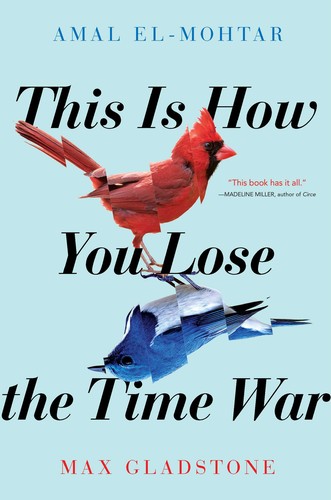
This Is How You Lose the Time War
Saga Press · 2019 · 208 pages
ISBN: 9781534431003
Review Editor
Marcus Webb
Summary
Two agents are at war across time. Red serves the Agency, a technological utopia that controls the future through careful manipulation of historical threads. Blue serves the Garden, an organic, biological civilization with an equally determined vision of what the future should be. Their respective civilizations have been fighting across centuries and millennia, altering events, planting seeds, and unraveling each other’s work in an endless conflict for the shape of what comes next.
Red and Blue encounter each other’s handiwork long before they meet, and they begin leaving taunting notes. The notes become letters. The letters become something neither anticipated. This Is How You Lose the Time War is a novella by Amal El-Mohtar and Max Gladstone that won the Hugo, Nebula, and Locus Awards for Best Novella in 2020, and it is one of the most formally beautiful works of speculative fiction published in the twenty-first century.
The letters are hidden in extraordinary places: the rings of ancient trees, the crystallized light of dying stars, the veins of a dying soldier on a field centuries removed from everything either of them calls home. The premise, at its most reductive, is that two enemies fall in love. But the mechanism of that love and the prose in which it is rendered make any simple summary inadequate. This is a book that cannot be summarized without losing the thing that makes it what it is.
Character Arcs and Development
Red and Blue are not developed in the conventional sense. They do not have backstories systematically revealed, nor character flaws progressively addressed. What develops is their understanding of each other, and through that, their understanding of themselves. The arc is epistolary and emotional rather than procedural, a distinction that matters enormously for what kind of reading experience the novel provides.
Red is described as fiercer, more martial, more comfortable in the Agency’s technological certainty. Her early letters hold the quality of superiority barely in check, condescension that has not yet decided what it is. Blue’s letters are more playful from the beginning, more attentive to beauty, more willing to admit what she does not know. The contrast between them is not between good and bad but between two orientations toward existence, and the novel is the story of how those orientations are gradually and irrevocably modified by contact with each other.
The antagonists are not other individuals but the civilizations each serves. The mechanics of betrayal the plot requires are among the most genuinely painful in recent speculative fiction, precisely because the characters’ divided loyalties are entirely comprehensible and entirely insufficient protection against what they cost. When the consequences arrive, the reader feels them as the characters do: as the price of having found something irreplaceable in an impossible place.
There is something almost unbearably moving about how Red and Blue are changed not by shared experience but by shared language. They have never been in the same room. They have exchanged nothing but words hidden in the world. And yet what they have built across those letters is as real as anything the novel depicts, and the novel makes you feel that reality completely.
Pacing
The novella’s pacing is unlike anything else in the genre. It does not build toward a conventional climax; it spirals inward, each letter bringing Red and Blue closer through correspondence that spans centuries and continues to surprise. Historical settings shift constantly, each rendered with the compression of a haiku: a few details that conjure a world entire, without ever staying long enough to become comfortable.
At 208 pages, it is short enough to read in a single sitting, and this is probably the correct way to read it. The experience of the letters accumulating, the relationship building, the language deepening, all works best when not interrupted by the rhythms of ordinary life. The pace accelerates toward the end in a way that feels inevitable rather than rushed, as if the letters have been pulling toward their conclusion all along and reader and characters are only now catching up to where the story was always going.
The sections between letters, the action sequences in which Red and Blue carry out their missions, are written in a more abbreviated style that highlights the letters’ relative richness. The missions are where the war happens; the letters are where the story happens. Structurally and stylistically, the division is perfect and instructive about what the authors believe matters.
Deeper Thematic Exploration
The novel’s most explicit theme is the power of language to create meaning across impossible distances. Red and Blue cannot meet safely. They communicate through letters hidden in the physical world with extraordinary ingenuity, and those letters become the only reality that matters to either of them. El-Mohtar and Gladstone are making an argument about correspondence itself: the particular intimacy created when two people who cannot share space share words across time, the way that language can build a self-contained world between two minds that nothing else can fully access.
There is also a quieter argument about certainty. Red’s Agency and Blue’s Garden are both absolutely certain they are right about the future, and their war has continued so long that neither can remember a time before it. The love between Red and Blue is dangerous not only because they are enemies but because it introduces doubt into systems built on certainty. To love someone committed to a different vision of the world is to become unable to fully commit to your own. Chambers presents this not as a weakness but as a form of wisdom: the recognition that certainty is not the same as correctness.
The formal structure of the novella enacts its argument. Two authors writing in voices distinct but not separately attributed became, in the writing of this book, something neither was alone. The result is a text that is genuinely collaborative in its DNA, a demonstration that the selves we build together can be more than either contributes separately. This is not merely a formal experiment; it is the novel’s central argument made visible at the level of authorship itself.
Style and Voice
The prose is, without qualification, extraordinary. El-Mohtar and Gladstone write at the level of poetry in significant passages, and the language itself becomes the novel’s primary pleasure. Sentences arrive with the weight of things carefully made, and the imagery is consistently surprising without being obscure: this is not difficulty for its own sake, but precision applied to the project of conveying experiences that do not have conventional language, feelings that exist only in the space between two people who have no right to feel them.
The letters in particular are masterpieces of compressed emotional intelligence. Each one advances the relationship, reveals character, conveys a setting, and demonstrates the letter-writer’s state of mind through the specific objects and images they choose to notice. The technique is epistolary fiction at its highest expression, and readers who love the form will find this the most achieved example of it they have read. The choices of what to hide in, and where, and how to explain those choices: all of it reveals. All of it means.
The prose in the action sections is deliberately more spare, which makes the transitions between modes feel like surfacing from water. The reader experiences what Red and Blue experience: the war is something you endure. The letters are something you live in.
Verdict
This Is How You Lose the Time War is a triumph of speculative fiction and of contemporary literary craft. It achieves something that very few books manage: formally innovative without being inaccessible, emotionally devastating without being sentimental, and intellectually serious without being cold. It is, before everything else, a love story, and one of the most beautiful love stories written in any form in recent decades.
Its triple crown of awards is deserved. Its reputation among readers who have found it is deserved. What it offers that cannot be summarized or represented in a review is the experience of reading it, which is unlike anything else and which tends to produce the kind of response that readers reach for books to produce: the feeling of having been, for a few hours, somewhere entirely real that does not exist on any map. Red and Blue feel as real as any characters you have spent this little time with, and the world they have built between themselves in letters feels worth preserving.
Five stars, recommended without reservation, and best read with a glass of something warm and several uninterrupted hours ahead of you. Let the letters accumulate. Let the language work on you. This is one of the best novellas of the century so far.
Is this suitable for readers who don’t usually read science fiction?
Particularly suitable. The novel’s science fiction elements are present but not foregrounded as technical puzzles. The story works equally well as a literary love story told through extraordinary correspondence. Readers who love epistolary fiction, poetry, or simply beautiful prose will find the genre elements unintimidating, and the emotional core is universal.
Who wrote which sections of the book?
El-Mohtar and Gladstone have described a close collaboration in which sections were not strictly divided and both authors revised each other’s work substantially. In general, El-Mohtar was primarily responsible for Blue’s voice and Gladstone for Red’s, but the seams have been made deliberately invisible. The novel presents itself as a unified text rather than alternating chapters, and readers should experience it as such rather than looking for the join.
What awards did this book win?
It won all three major English-language science fiction awards for novella: the Hugo, Nebula, and Locus Awards, all in 2020. This clean sweep is extremely rare, particularly for a work that is simultaneously a debut in this specific form for both authors. It has also appeared on countless best-of lists for the year and the decade.
Does the book explain how time travel works?
Deliberately not in any technical detail. The mechanics of Red and Blue’s time manipulation are suggestive rather than systematic; they work through strands and influence historical nodes, but the novel is not interested in the engineering of time travel. This is a book about correspondence and love, and the time war is its setting rather than its subject. Readers seeking hard science fiction explanations will need to look elsewhere; readers seeking emotional authenticity will find it here in full.
How long is This Is How You Lose the Time War?
The novella is 208 pages. Most readers complete it in two to four hours. Because of the density and beauty of the prose, many readers find they read more slowly than usual, pausing over particular sentences. The experience of reading it is often described as disproportionately large relative to its physical size: it contains more than its pages.
Is this part of a series?
No, it is a standalone work. Its ending is complete, and neither author has announced plans for a sequel. The story reaches a resolution that does not require continuation, and the consensus among readers who love it is that continuation would not improve on what exists.
What format works best for reading this book?
Many readers who love the book most read it physically in print and in a single sitting. The letters are beautifully designed in the hardcover and paperback editions, using typography to distinguish them from the prose sections. The audiobook is also well-produced. The reading experience is best when uninterrupted; the accumulation of the letters’ imagery and language creates a cumulative effect that benefits from continuity.
What other books would you recommend if I loved this one?
Readers responding to the prose and the epistolary form might also enjoy Kazuo Ishiguro’s The Remains of the Day for its quality of longing expressed through restraint, or Flowers for Algernon by Daniel Keyes for another science fiction narrative driven by correspondence. Within speculative fiction, Becky Chambers’s Wayfarers novels and Le Guin’s The Left Hand of Darkness offer similar emotional intelligence. For more of El-Mohtar’s work, her short story collection demonstrates her range. For more Gladstone, the Craft Sequence novels show a writer with considerable scope.
Book Details
- Title
- This Is How You Lose the Time War
- Genre
- Science Fiction
- Publisher
- Saga Press
- Year Published
- 2019
- Pages
- 208
- ISBN
- 9781534431003
- WritersReview Rating
- 5.0 / 5