Amal El-Mohtar and Max Gladstone
Amal El-Mohtar and Max Gladstone are two of the most celebrated writers in contemporary speculative fiction, and This Is How You Lose the Time War (2019) represents their only collaborative work to date — a novel that reads as though it could only have been written by exactly this pair, at exactly this moment. El-Mohtar was born in Ottawa, Canada, to Lebanese parents, and has built a reputation as a poet, critic, and short fiction writer whose work draws on Arabic literary traditions, mythology, and a lyrical intensity rare in the genre. Gladstone was born in 1984 in rural Ohio and grew up in China, where he taught English before pursuing a career as a novelist. He studied at Yale Divinity School and has written a series of interconnected novels — the Craft Sequence — that explore the intersection of magic, law, capitalism, and decolonization with unusual intellectual rigor.
El-Mohtar is the author of The Honey Month (2011), a collection of poetry and short fiction, and has been a Hugo Award-winning critic and essayist. She has served as poetry editor for Uncanny Magazine and as a regular books columnist for NPR and the New York Times Book Review. Her short fiction has won the Hugo, Nebula, and Locus Awards multiple times. Gladstone’s Craft Sequence — comprising Three Parts Dead, Two Serpents Rise, Full Fathom Five, Last First Snow, and A Great Unreckoningg — has won devoted critical praise for its ambition, its moral complexity, and its ability to make economic and legal systems feel as strange and dangerous as any dark magic.
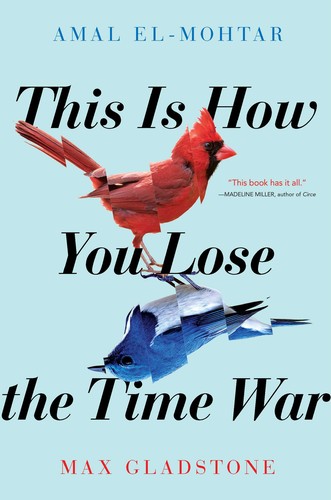
This Is How You Lose the Time War, available on WritersReview, is an epistolary novel told entirely through letters exchanged between two agents — Red and Blue — who work for opposing factions in a war fought across time. The two women begin as enemies, leave messages for each other in improbable places across history and prehistory, and gradually fall into something that transcends the categories of rivalry and love alike. The novel is written in prose of extraordinary beauty — dense with metaphor, alive to the textures of different times and places — and it unfolds its emotional stakes with a restraint that makes the eventual declaration of feeling all the more overwhelming.
The book won the Hugo Award, the Nebula Award, and the Locus Award for Best Novella in 2020, a rare triple crown. Critics praised the audacity of its formal conceit, the quality of its writing, and the way it made the abstraction of time travel feel intimate and embodied. It is widely regarded as one of the finest works of speculative fiction of the decade, and has found a devoted readership well beyond the genre’s traditional boundaries.
The collaboration between El-Mohtar and Gladstone has been described by both authors as a genuine creative exchange — each pushing the other’s prose to greater heights, each bringing a different set of references and obsessions to the shared project. Their combined body of work, in short fiction, poetry, criticism, and long-form fiction, represents some of the most vital and formally adventurous writing in contemporary speculative literature.