
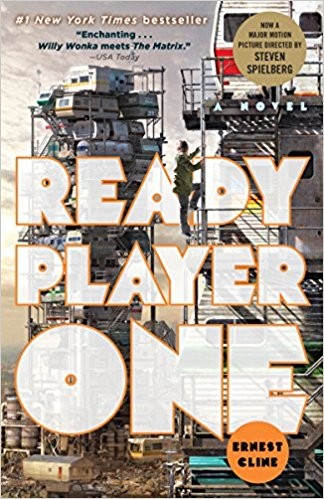
Ready Player One
Crown Publishers · 2011 · 374 pages
ISBN: 9780307887443
Review Editor
Marcus Webb
Summary
In 2044, the real world has become difficult to bear. Energy shortages, economic collapse, and environmental degradation have made ordinary life grim enough that most of humanity spends its waking hours in the OASIS, a free-access virtual reality universe developed by the reclusive programmer James Halliday. The OASIS is immense, containing thousands of virtual planets and everything from schools to shopping districts to elaborate simulated worlds drawn from every corner of human pop culture.
When Halliday dies, he leaves his entire fortune — the controlling interest in the corporation that runs the OASIS itself — to whoever can solve a series of puzzles hidden within the simulation. The puzzles are designed around Halliday’s obsession with 1980s pop culture: the films, music, television, and video games he grew up with. To win, contestants must become authorities on the decade’s cultural output.
Wade Watts is eighteen, orphaned, and living with his aunt in the “stacks” — the trailer parks of the future, where homes are literally stacked on top of each other to economize on land. He is a “gunter” (egg hunter), one of millions pursuing Halliday’s contest, and one of the few who has done the work to master every corner of the man’s biography and obsessions. When Wade solves the first puzzle, he is catapulted into a competition against thousands of other gunters and against the corporate entity IOI, which wants to win the contest to put the OASIS behind a paywall.
Ernest Cline’s debut novel is a love letter to a particular decade’s cultural moment, a propulsive adventure novel, and, buried under the nostalgia, a genuinely interesting meditation on the relationship between virtual experience and authentic life.
Character Arcs and Development
Wade Watts — screen name Parzival — begins the novel as a somewhat passive character defined primarily by his obsessions and his marginalization. His journey through the contest is also a journey toward agency: he makes increasingly significant choices, forms real alliances with people he has only met virtually, and ultimately has to decide what he is willing to risk physically for something that exists entirely in a simulation.
The relationship between Wade and Art3mis, the female gunter he develops feelings for, is the novel’s most interesting character dynamic and also its most frustrating. Their connection develops almost entirely in the OASIS, and the novel is honest about the ways that virtual intimacy can substitute for real connection rather than building toward it. Art3mis actively resists the relationship for reasons that make sense within the novel’s thematic concerns, and her resistance is more interesting than Wade’s pursuit. She is not wrong that intimacy built on shared reference points in a virtual world is not the same as knowing someone.
The other primary characters — Aech, Shoto and Daito — are efficiently drawn. Aech in particular, whose real identity constitutes one of the novel’s more thoughtful reveals, demonstrates Cline’s awareness that the OASIS’s promise of identity liberation comes with its own complications. The antagonist, IOI’s “Sixers” and their supervisor Sorrento, is more functional than dimensional, which is the novel’s weakest character choice.
Pacing
Ready Player One moves with the momentum of a video game, which is entirely intentional. Cline structures the novel around the progression of the contest — each puzzle solved advances the story as clearly as a level completion — and the momentum rarely flags. The novel’s greatest pacing achievement is making the contest feel genuinely competitive and dangerous even when the protagonist is clearly going to win, which is a challenge all quest narratives face.
The action sequences, particularly the climactic assault on the final gate, are written with game-designer precision: the stakes are clear, the obstacles are specific, and the resolutions feel earned rather than arbitrary. Cline knows exactly what kind of book he is writing and executes within those parameters with confidence.
The sections in the real world are less compelling but necessary. The periodic intrusions of Wade’s actual physical circumstances — hunger, danger, the limitations of his body — serve the novel’s thematic argument even when they slow its narrative momentum.
Deeper Thematic Exploration
The novel’s most interesting questions are the ones it asks almost incidentally: what do we lose when we substitute virtual experience for physical life? Why does nostalgia for a particular cultural moment become the organizing principle of an entire civilization? What does it mean that the highest aspiration millions of people can articulate is to win control of a fictional universe?
Cline does not always press these questions as hard as the novel might. The ending resolves the plot without fully resolving the tension between Halliday’s OASIS and the real world that exists outside it. But the questions are there, audible beneath the nostalgia and the adventure, and readers who want to take the novel seriously on those terms will find material to work with.
The figure of James Halliday is more complex than a MacGuffin. His biography, gradually revealed through the contest’s clues, is a portrait of someone who was brilliant at creating worlds for other people to inhabit and completely unable to inhabit his own. His nostalgia for the 1980s is presented not as enthusiasm but as retreat, a failure to engage with a present he found too difficult. The OASIS, his great achievement, is also the expression of that failure. This gives the novel a melancholy center that its pop-culture surface doesn’t quite prepare readers for.
Style and Voice
Cline’s prose is clear and serviceable, designed to carry plot rather than pause on it. The first-person narration conveys Wade’s voice credibly — he is a teenager defined by his enthusiasms, and the prose has appropriate teenage energy without becoming tiresome. The cultural references that populate the text function as Cline intends: as signals of authenticity to readers who share the references, and as evidence of the characters’ expertise for those who don’t.
The novel’s most significant stylistic limitation is its approach to exposition. Cline sometimes stops the narrative to explain a reference at length, and while these passages can be interesting as cultural history, they slow the forward momentum that is the novel’s greatest asset. Readers who share Cline’s enthusiasms will engage with these passages as fans; those who don’t may find them dutiful.
The dialogue is occasionally on-the-nose — characters sometimes say exactly what they mean in moments that call for indirection — but this is a minor complaint against a novel that does not aspire to literary subtlety and delivers on its actual ambitions with considerable skill.
Verdict
Ready Player One is a genuinely enjoyable novel that does what it sets out to do with skill and affection. It is a love letter to a particular cultural moment, a propulsive adventure story, and a surprisingly thoughtful meditation on what we use virtual worlds for and what they cost us. Its weaknesses are real: the protagonist is initially passive, the cultural references sometimes overwhelm the story, and the antagonists are underdeveloped. But these are secondary complaints against a novel that builds and maintains genuine momentum, creates a world that feels consistent and inhabited, and asks questions about virtual escapism that are more urgent now than when it was published.
Readers who share Cline’s enthusiasm for 1980s pop culture will find this book almost unreasonably pleasurable. Readers who don’t share that enthusiasm will still find a competent adventure novel with more thematic ambition than its surface suggests. Either way, it is a compelling reading experience and a four-star achievement in the difficult genre of nostalgic adventure fiction.
Do you need to know 1980s pop culture to enjoy Ready Player One?
No, though familiarity helps. Cline provides enough context for the references to function even for readers who lack direct knowledge of the source material, and the narrative appeal does not depend on recognizing every allusion. That said, readers who grew up with the films, games, and music Cline references will find an additional layer of pleasure in recognition that genuinely enhances the reading experience.
How does the movie compare to the book?
Steven Spielberg’s 2018 film adaptation is broadly faithful in premise and significantly different in its specific cultural references, partly for rights reasons and partly because Spielberg drew more heavily from his own filmography. The film is visually spectacular and fast-paced; it simplifies some plot elements and changes the specific puzzles of the contest. Most readers find both versions enjoyable on their own terms, though the book provides considerably more context for Halliday’s biography and motivations.
Is there a sequel to Ready Player One?
Yes, Ready Player Two was published in 2020. It continues Wade’s story after the events of the first novel, with a new contest and new stakes. Critical reception was more mixed than for the original novel, with reviewers noting that the formula felt more mechanical in its second application. Readers who loved the first book will find familiar pleasures; those hoping for significant thematic or stylistic development may be disappointed.
What is the OASIS and how does it work?
The OASIS is a massively multiplayer online simulation developed by James Halliday’s company, accessible via haptic suits, visors, and gloves, or through simpler interface devices. It functions as a global virtual reality environment containing thousands of planets, each with different rules and themes. Access is free, though many in-world items cost real currency. The OASIS serves as school, workplace, and social environment for much of the novel’s population, raising the real-world stakes of who controls it.
What does Ready Player One say about escapism?
More than it might initially appear. The novel’s OASIS is presented as both understandable refuge from a difficult world and as symptom of civilizational failure. Halliday himself, the OASIS’s creator, is revealed as someone who retreated from authentic life into virtual worlds and missed the real relationships that were available to him. The novel does not condemn escapism wholesale, but it is clear-eyed about what it costs. The ending’s gesture toward the physical world reads as genuinely earned rather than tacked on.
Who is Art3mis and what is her role?
Art3mis is a rival gunter and popular video blogger who becomes Wade’s primary love interest. She is arguably the novel’s most interesting character precisely because she is more resistant to the OASIS’s promise of identity transcendence. Her awareness of the gap between virtual intimacy and real connection provides the novel’s most thoughtful counterpoint to Wade’s enthusiasm, and her eventual character choices are more interesting than her initial role as romantic object would suggest.
Is Ready Player One appropriate for younger readers?
Yes, with some caveats. The novel is written for a young adult or adult audience and contains mild violence and romantic content without explicit scenes. Its protagonist is eighteen, its concerns are ones that resonate across age groups, and its cultural nostalgia makes it particularly accessible to readers in their thirties and forties who remember the decade it celebrates. Younger readers unfamiliar with the references should still find the adventure plot engaging.
What makes the contest in Ready Player One interesting?
The contest is essentially a puzzle hunt through cultural history, and Cline designs it with the logic of a game designer: each puzzle builds on the previous one, each solution requires genuine mastery of the material rather than lucky guessing, and the progression feels organic rather than arbitrary. The contest also functions as a structural device that keeps the narrative focused and propulsive while allowing Cline to explore different corners of his meticulously constructed world.
Book Details
- Title
- Ready Player One
- Author
- Ernest Cline
- Genre
- Science Fiction
- Publisher
- Crown Publishers
- Year Published
- 2011
- Pages
- 374
- ISBN
- 9780307887443
- WritersReview Rating
- 4.0 / 5