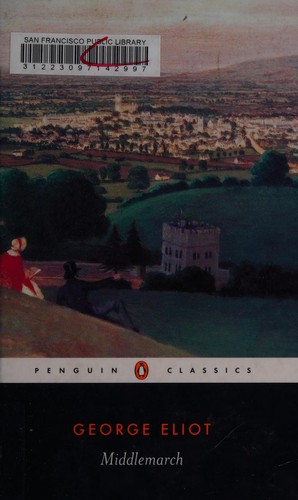
George Eliot
George Eliot was the pen name of Mary Ann Evans, born on November 22, 1819, in Nuneaton, Warwickshire, England, the daughter of an estate agent. She adopted a male pseudonym to ensure that her fiction would be taken seriously on its literary merits rather than dismissed as mere feminine entertainment, a necessary calculation in the Victorian literary marketplace. Her childhood in the English Midlands, with its farming communities, provincial towns, and Nonconformist religious culture, provided the social and moral landscape for much of her fiction. She was exceptionally well educated for a woman of her time — reading widely in German philosophy, classical literature, and natural science — and worked as a translator and journalist, producing important translations of Strauss’s Life of Jesus and Feuerbach’s Essence of Christianity before turning to fiction at the age of thirty-seven.
Eliot’s personal life was unconventional by Victorian standards. From 1854 until his death in 1878, she lived with the philosopher and critic George Henry Lewes, who was legally unable to divorce his estranged wife. Their relationship, though condemned by many in society, was intellectually and emotionally sustaining, and Lewes was the devoted supporter and editor of her writing life. After his death, she married her much younger friend and financial adviser John Walter Cross in 1880; she died later that same year. Her relationship with Lewes in particular gave her an intimate understanding of the costs of living outside social convention that deeply informed her fiction’s moral imagination.
Middlemarch, published in installments in 1871-72, is her masterpiece and is widely regarded as the greatest novel in the English language. Set in the fictional English Midlands town of Middlemarch during the period of parliamentary reform in the early 1830s, it weaves together multiple narrative strands — most centrally the story of Dorothea Brooke, an idealistic young woman who makes a catastrophically ill-judged marriage to the elderly scholar Casaubon, and Tertius Lydgate, an ambitious young doctor whose scientific idealism is undercut by a disastrous marriage to the beautiful Rosamond Vincy. The novel’s scope is panoramic but its psychological observation is microscopically precise, and its moral vision — humane, non-dogmatic, rooted in a sympathetic understanding of human fallibility — is among the most admirable in all of literature.
Eliot’s prose style is characterized by an extraordinary intellectual density combined with a deep emotional warmth. She writes with the authority of a thinker who has read everything and felt everything, and her narrative voice — authoritative, ironic, compassionate — is one of the great instruments in English fiction. Her famous passages of moral reflection, which step back from the immediate narrative to consider the broader human condition, have a philosophical weight that is entirely integrated into the emotional fabric of the story.
George Eliot’s influence on the English novel has been enormous. Henry James, who considered her the greatest living English novelist, learned from her the possibilities of narrative consciousness; Virginia Woolf celebrated her in an essay that begins with the declaration that Middlemarch is ‘one of the few English novels written for grown-up people.’ Her work stands as the supreme achievement of the Victorian novel’s ambition to render the full complexity of human social and moral life.