
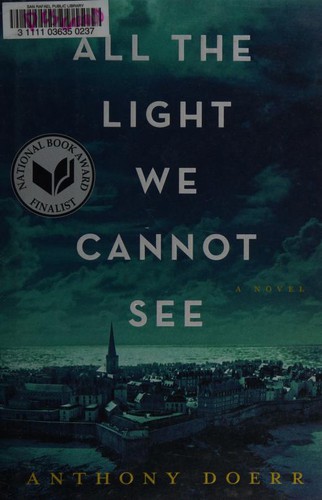
All the Light We Cannot See
Scribner · 2014 · 544 pages
ISBN: 9781476746586
Review Editor
Claire Beaumont
Summary
Anthony Doerr’s All the Light We Cannot See, published in 2014 and awarded the Pulitzer Prize for Fiction in 2015, is a World War Two novel told through two alternating perspectives: Marie-Laure LeBlanc, a blind French girl who flees Paris with her father as the Germans advance, and Werner Pfennig, a German orphan whose extraordinary talent with radio technology draws him into the Nazi war machine. The novel follows both characters across years of war and converges, in its final section, in the French city of Saint-Malo during the siege of 1944.
The title refers to radio waves, which carry voices and music across vast distances invisibly, and to the light of grace and love that persists unseen through the darkness of war. Doerr is interested in what people can and cannot perceive: Marie-Laure’s blindness and her remarkable tactile and auditory sensitivity, Werner’s radio skills and his growing inability to see clearly what he is participating in, and the ways in which ordinary people in extraordinary circumstances choose what to notice and what to look away from.
The novel took Doerr a decade to write, and the care shows. It is meticulously researched, intricately structured, and built on a level of sensory detail that makes both the beauty of peacetime Europe and the devastation of war feel equally immediate. It became one of the most celebrated American novels of the decade, selling over fifteen million copies worldwide.
Character Arcs and Development
Marie-Laure is one of the most fully realized protagonists in recent historical fiction. Her blindness is rendered not as a limitation to be overcome but as a different mode of perception, one that gives her an intense relationship with the physical world. Her father builds her elaborate models of the neighborhoods they live in so she can navigate by touch, and these models become one of the novel’s central images: a representation of the care and imagination that love requires. Marie-Laure’s relationship with her father is the novel’s most tender, and his disappearance partway through creates a wound that shapes everything that follows.
Werner is the novel’s more complex figure. His trajectory is a study in incremental moral compromise: a brilliant, sensitive child who ends up serving a regime he never fully believes in, partly through fear, partly through self-deception, and partly because the alternatives always seem to require more courage than he can summon. Doerr does not demonize Werner or excuse him, and the result is a portrait of ordinary complicity that is more disturbing than a simple portrait of villainy would be. Werner knows, at some level, what is wrong. He continues.
Von Rumpel, the Nazi officer hunting a legendary diamond that Marie-Laure may be concealing, functions as the novel’s antagonist, and Doerr is careful to make him a recognizable human type rather than a monster: a man dying of cancer who believes the diamond’s supposed powers will save him. His obsession is both banal and terrifying, and his pursuit of Marie-Laure provides the thriller structure that keeps the novel’s more meditative passages in motion.
Pacing
Doerr structures the novel in very short chapters, many of them only one or two pages long, alternating between Marie-Laure and Werner across multiple time periods. The effect is to create a kind of cinematic intercutting that keeps the pace high despite the novel’s considerable length. Each short chapter ends at a moment of mild tension or beauty or mystery, creating a forward pull that makes the novel unusually readable for something of its ambition and density.
Some readers find the structure too relentless, the chapters too short to allow full immersion in any one moment before the perspective shifts. This is a fair response. The technique is effective at maintaining pace but occasionally prevents the novel from achieving the sustained depth that its best passages suggest it is capable of. The convergence in Saint-Malo, when the two timelines finally meet, is the novel’s most sustained single-point-of-view sequence, and it is also its most powerful: the structure relaxes just enough to let the emotional consequences fully land.
Deeper Thematic Exploration
The novel’s deepest subject is how ordinary people negotiate complicity in systems of violence. Werner’s arc is the moral center: his early idealism, his understanding that the reality of the Nazi state does not match its promises, and his incremental accommodation to what he is being asked to do constitute a psychological study that has resonance well beyond its specific historical setting. Doerr is asking what it takes to say no, and suggesting that the question is much harder than most people imagine when they are not in the situation.
The diamond, the Sea of Flames, carries a curse: whoever possesses it will live forever but bring catastrophe to everyone they love. This allegorical element allows Doerr to address the price of accumulation and power without becoming schematic: the diamond functions as a symbol of the things people destroy themselves and others to possess while living just long enough to see what the possession has cost. It is handled with sufficient lightness that it does not collapse into allegory, but the symbolic weight is always present.
Radio technology is the novel’s third great theme. Radio connects Werner and Marie-Laure before they ever meet: as a child in the orphanage, Werner listens to broadcasts that include the voice of Marie-Laure’s great-uncle, a naturalist who broadcasts from Saint-Malo. Doerr uses radio to think about the invisible transmissions between people, the ways that broadcasts of music and science and human voice can persist through and despite the noise of war. The novel ends with a meditation on these transmissions that is one of its most beautiful passages.
Style and Voice
Doerr writes in a prose style that is lyrical without being ornate, specific without being pedantic, and emotionally direct without being sentimental. He has a naturalist’s eye for the physical world: the texture of bread, the smell of the sea, the specific quality of light through a particular kind of glass. This attention to the sensory world is especially effective in the sections narrated from Marie-Laure’s perspective, where it serves the character’s way of knowing as well as the novel’s atmospheric ambitions.
The short chapter structure means that Doerr is constantly beginning again: each chapter is a small unit of meaning that must quickly establish its own voice and trajectory before yielding to the next. This is difficult to do well and Doerr does it well, finding ways to make each short chapter feel complete rather than truncated. The result is a novel that reads more quickly than its length suggests and that rewards close attention to the way individual chapters function as prose poems as well as narrative units.
Verdict
All the Light We Cannot See is the kind of historical novel that makes you feel the past as present tense: visceral, specific, and morally alive. It does not sentimentalize war or romanticize the Resistance or give Werner an easy redemption. It is honest about the costs of complicity, the randomness of survival, and the way beauty and violence coexist in the same world at the same time. Its ambitions are fully realized.
For readers interested in World War Two fiction, it belongs alongside the very best work in that tradition: Hilary Mantel’s Wolf Hall in its level of historical imagination, Patrick Modiano in its sense of how the past persists in the present. For readers coming to it fresh, it is simply one of the finest American novels of the past twenty years. The Pulitzer was earned.
Frequently Asked Questions about All the Light We Cannot See
What is All the Light We Cannot See by Anthony Doerr about?
All the Light We Cannot See follows two characters across World War Two: Marie-Laure LeBlanc, a blind French girl who flees Paris with her father and eventually ends up in Saint-Malo, and Werner Pfennig, a German orphan whose talent with radio technology draws him into the Nazi war machine. The novel alternates between their perspectives across several years, converging in Saint-Malo during the 1944 siege. It is about complicity, survival, the invisible transmissions that connect people, and what ordinary people do when faced with extraordinary moral demands.
Why did All the Light We Cannot See win the Pulitzer Prize?
All the Light We Cannot See won the 2015 Pulitzer Prize for Fiction for its extraordinary craft, its moral seriousness, and its ability to make a familiar historical period feel fresh and immediate. The Pulitzer board cited its intricate structure, its fully realized characters, and its willingness to engage with questions of complicity and moral compromise without offering easy answers. It was widely regarded as one of the most ambitious and successful American novels of the decade.
Is All the Light We Cannot See based on a true story?
All the Light We Cannot See is a work of fiction, though it is set against accurately researched historical events, including the German occupation of France, the siege of Saint-Malo in 1944, and the specific mechanisms of the Nazi war machine. The characters of Marie-Laure and Werner are invented, as are the specific events of the plot. Doerr spent a decade researching and writing the novel, and the historical backdrop is rendered with considerable accuracy.
Is there a Netflix adaptation of All the Light We Cannot See?
Yes. Netflix produced a four-part limited series adaptation of All the Light We Cannot See in 2023, starring Aria Mia Loberti as Marie-Laure and Louis Hofmann as Werner, with Mark Ruffalo as Marie-Laure’s father. The adaptation was directed by Shawn Levy. Critical reception was mixed, with many reviewers noting that the compressed format could not fully replicate the novel’s slow accumulation of detail and moral complexity. Readers of the novel generally found the adaptation visually striking but emotionally thinner than the source material.
What does the title All the Light We Cannot See mean?
The title refers primarily to radio waves, which carry voices, music, and information invisibly across vast distances and were central to both German military communications and Allied resistance networks during the war. More broadly, it refers to the things we cannot perceive but that shape us: the invisible forces of love, grace, and human connection that persist through and despite violence. Marie-Laure cannot see light in the conventional sense, but she perceives the world with an intensity that makes her the novel’s moral center of vision.
How long is All the Light We Cannot See and is it worth reading?
All the Light We Cannot See is approximately 544 pages, but it reads faster than its length suggests because Doerr structures it in very short chapters, many only one or two pages long, that alternate between the two main characters. Most readers report that the pace feels propulsive despite the length. It is absolutely worth reading for anyone interested in World War Two fiction, character-driven historical novels, or American literary fiction at its most ambitious. It is one of the finest novels of its decade.
Who is Werner Pfennig in All the Light We Cannot See?
Werner Pfennig is an orphaned German boy from the coal-mining town of Zollverein who has an extraordinary gift for understanding and building radios. His talent attracts the attention of the Nazi educational system and draws him away from the orphanage and into the Hitler Youth and eventually the German army. Werner is the novel’s most morally complex character: an essentially decent person who incrementally accommodates himself to a system he knows is wrong, partly through self-preservation and partly through a failure of courage that Doerr portrays without sentimentality or easy condemnation.
What other books are similar to All the Light We Cannot See?
Readers who loved All the Light We Cannot See often respond to Kate Atkinson’s Life After Life, which shares its interest in World War Two, its structural experimentation, and its dual narrative perspectives. The Nightingale by Kristin Hannah covers similar French wartime territory with more emotional directness and is frequently recommended together with Doerr’s novel. For readers drawn to the moral questions about complicity and survival, Jonathan Littell’s The Kindly Ones and Ian McEwan’s Atonement both engage with related territory in different ways.
Book Details
- Title
- All the Light We Cannot See
- Author
- Anthony Doerr
- Genre
- Literary Fiction
- Publisher
- Scribner
- Year Published
- 2014
- Pages
- 544
- ISBN
- 9781476746586
- WritersReview Rating
- 5.0 / 5