
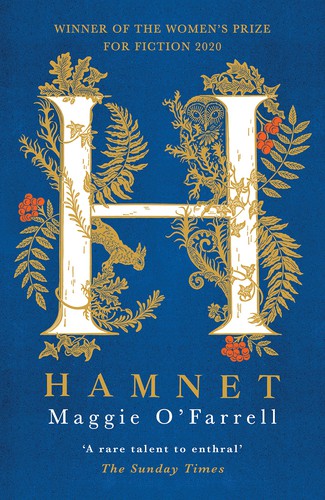
Hamnet
Tinder Press · 2020 · 352 pages
ISBN: 9781472223791
Review Editor
Claire Beaumont
Summary
Maggie O’Farrell’s Hamnet, published in 2020, is a novel about grief, love, and the plague, set in Stratford-upon-Avon in the late sixteenth century. It tells the story of Agnes (as William Shakespeare’s wife Anne Hathaway was known locally) and the death of her son Hamnet at age eleven in 1596, the year before Shakespeare wrote the play that would bear his son’s name. The novel does not name Shakespeare directly: the husband and father is referred to throughout as “the Latin tutor,” or simply “he,” a choice that focuses attention on Agnes and the children who are typically absent from the historical record.
The novel moves between two timelines: the story of Agnes and the young William as they fall in love and build a life together in Stratford, and the terrible summer of 1596, when the plague arrives and Hamnet dies. O’Farrell has taken what is essentially a biographical footnote, the death of a child we know almost nothing about, and imagined from it an entire world: the textures of domestic life in Elizabethan England, the specific quality of a mother’s love for a mercurial child, and the way grief reshapes everything it touches.
Hamnet won the Women’s Prize for Fiction in 2020 and became one of the most celebrated literary novels of recent years. It is the kind of book that reminds you what historical fiction at its best can do: restore interiority and emotional complexity to people that history has flattened into names on a record of birth or death.
Character Arcs and Development
Agnes is one of the most vividly realized characters in recent literary fiction. O’Farrell describes her as she might be perceived by the people of Stratford: wild, strange, gifted with an uncanny ability to read people and animals, never entirely comfortable with the domestic expectations of her time. She has a physical and spiritual specificity that makes her leap off the page. Her love for the young William Shakespeare is rendered as something intense and particular, a recognition of someone as strange as herself in a world that finds them both difficult.
Hamnet himself is present for a relatively small portion of the novel, and O’Farrell is careful not to make him simply a symbol of loss. He is a specific child: curious, anxious, deeply attached to his twin sister Judith, trying to understand a father who is largely absent. The scenes between the twins are some of the most affecting in the novel, capturing the particular intimacy of twinship and the particular terror of one twin watching the other fall ill.
The young William, glimpsed in the novel’s earlier sections, is drawn with a kind of wondering attention: a man shaped by his wife’s extraordinary character, moved by her, sometimes frightened by her, and never quite equal to the life she would have had them live together. O’Farrell’s refusal to name him is also a way of keeping him at a slight remove, as if we are seeing him through Agnes’s eyes, which find him both magnetic and ultimately insufficient.
Pacing
O’Farrell structures Hamnet to build toward a grief we know is coming from the first pages. The novel opens with Hamnet running through the house looking for his parents during his twin sister’s illness, and we understand from the first chapter what will happen even if we do not know the details. This creates a particular kind of dread: the pleasure of the earlier sections, the falling-in-love story and the scenes of domestic life, is shadowed throughout by what we know is approaching.
The pacing is deliberate and sensory, more concerned with texture and atmosphere than with event. Readers who prefer plot-driven fiction may find it slow in places. But O’Farrell is building something cumulative: the emotional impact of the novel’s second half, when Hamnet falls ill and dies, depends entirely on how fully you have inhabited this world and these people. The slowness is load-bearing. And the final section, in which Agnes goes to London to see what her husband has made of their son’s death, delivers a conclusion that is both unexpected and completely right.
Deeper Thematic Exploration
Grief is Hamnet‘s central subject, but O’Farrell approaches it through the specific, material world of late sixteenth-century England rather than through abstraction. She traces, in one extraordinary chapter, the journey of the flea that will carry the plague from Alexandria to London to Stratford, and the effect is to show grief as something that arrives by accident, through a chain of ordinary contingencies, rather than through any design or meaning. The plague kills Hamnet because a flea bit a glassblower’s apprentice, and the glassblower made goods that traveled by ship. There is no reason. There is only the world, going about its business.
The novel also thinks carefully about what it means for an artist to transform private grief into public art. Agnes goes to see Hamlet performed in London without having told her husband she was coming, and the experience of watching the play is one of the most emotionally complex passages in recent literary fiction. O’Farrell is writing about what art can and cannot do with loss, about whether the transformation of grief into something beautiful is a form of healing or a form of betrayal, and she does not resolve the question cleanly. Agnes’s response is one of the most honest portrayals of the relationship between life and art I have read.
The novel is also, quietly, a book about marriage and its limits: the way two people can love each other genuinely and still not be able to give each other what the other most needs, the way ambition and domesticity pull in different directions, and the way grief either pulls partners together or drives them apart. Agnes and William love each other. The novel does not pretend otherwise. But it also shows, without judgment, how his absence and his work create a distance that grief makes permanent.
Style and Voice
O’Farrell’s prose in Hamnet is extraordinary: sensory, precise, and always alive to the physical world. She writes about Elizabethan domestic life with the specificity of someone who has done enormous research but has also fully imagined herself into the period rather than simply reporting on it. The smells of the house, the textures of the fabrics, the particular quality of light in different seasons: all of this is rendered with a vividness that makes the world feel genuinely present.
The decision to write primarily in present tense heightens the immediacy of the most difficult scenes. When Hamnet’s illness progresses and Agnes tries everything she knows to save him, the present tense makes the action feel like it is still happening, like there is still a chance, even as we know there is not. This is a technically difficult effect to sustain and O’Farrell sustains it beautifully. The novel also uses second person briefly for the chapter tracing the plague’s journey, which gives that chapter a strange, impersonal authority: this is what the world does, indifferently.
Verdict
Hamnet is a novel that earns its emotional impact through the careful, patient work of making you care about a family you know is going to be destroyed. By the time the grief arrives, it is not the grief of a historical footnote but the grief of people you have come to know. O’Farrell has done something genuinely difficult: she has written a novel about one of the most famous writers in history without making Shakespeare the point, and in doing so has given us something more moving and more truthful than any conventional literary biography could have managed.
This is a book for anyone who has ever lost someone and anyone who has wondered what it costs an artist to transform private pain into public beauty. It is slow and demanding and worth every page. It belongs on the shelf alongside the best historical fiction of the past twenty years.
Frequently Asked Questions about Hamnet
What is Hamnet by Maggie O’Farrell about?
Hamnet is a novel set in Stratford-upon-Avon in the late sixteenth century, imagining the life of Agnes (Anne Hathaway), wife of William Shakespeare, and the death of her son Hamnet at age eleven in 1596. The novel focuses on Agnes and the children rather than Shakespeare himself, who is never named directly. It moves between the love story of Agnes and the young William and the devastating summer when the plague takes Hamnet, ending with Agnes traveling to London to see the play Shakespeare has written in their son’s name.
Is Hamnet by Maggie O’Farrell based on historical fact?
Hamnet is historical fiction based on real people and events. William Shakespeare did have a son named Hamnet who died in 1596 at age eleven, shortly before Shakespeare wrote his famous play Hamlet. His wife, named Agnes or Anne Hathaway, did live in Stratford while Shakespeare worked in London. But the novel’s portrayal of their inner lives, their relationship, and the specific circumstances of Hamnet’s death is invented by O’Farrell. She has described her research process as extensive but her goal as imagining rather than reconstructing.
Why does Hamnet never name Shakespeare directly?
O’Farrell’s decision to never name Shakespeare directly in the novel is a deliberate way of decentering him and centering Agnes and the children instead. By calling him “the Latin tutor” or “he,” she keeps the focus on the domestic world of Stratford and on the people historical records have largely ignored. She has spoken about wanting to write a novel that gives Agnes her full interiority and her full life rather than positioning her as a supporting character in the story of a famous man.
Did the death of Hamnet Shakespeare inspire Hamlet the play?
The connection between Hamnet Shakespeare’s death and Shakespeare’s play Hamlet is one that scholars and biographers have long speculated about. The two names were interchangeable in Elizabethan England. Shakespeare wrote Hamlet approximately five years after his son’s death. O’Farrell’s novel treats this connection as emotionally real without making historical claims about Shakespeare’s creative process. The final sequence of the novel, in which Agnes attends a performance of Hamlet, is the most moving exploration of this possible relationship between life and art.
What prizes did Hamnet win?
Hamnet won the Women’s Prize for Fiction in 2020, one of the most prestigious literary awards in the English-speaking world. It was also longlisted for the Booker Prize and named one of the best books of 2020 by numerous publications. The novel was a significant international bestseller and brought O’Farrell, who was already a respected literary novelist in the UK, to a much wider global readership.
How historically accurate is the portrayal of life in Elizabethan England in Hamnet?
O’Farrell has spoken about doing extensive research into domestic life, trade, medicine, and daily routines in late sixteenth-century England, and the result is a novel with a genuine sense of the period’s textures and rhythms. The details of food, fabric, work, and social life feel grounded rather than decorative. However, the novel’s primary goal is imaginative truth rather than historical accuracy, and O’Farrell makes clear that much of what she writes about Agnes and her family is invented. The plague chapter, which traces the disease’s journey from Alexandria to Stratford, draws on historical records of plague transmission.
Is Hamnet a sad book?
Hamnet is a deeply affecting novel, and the death of a child is its central event, so yes, it is a sad book in a significant sense. But O’Farrell has structured it so that the sadness feels earned rather than manipulative, and the final section offers something closer to hard-won understanding than simple devastation. Most readers report that the emotional intensity is the point, not an obstacle. The novel is not relentlessly grim: the love story of Agnes and William and the vivid domestic world O’Farrell creates have genuine warmth and pleasure in them before the loss arrives.
What other books by Maggie O’Farrell should I read after Hamnet?
Readers who loved Hamnet often find similar pleasures in O’Farrell’s memoir I Am, I Am, I Am: Seventeen Brushes with Death, which applies the same intensity of physical and psychological attention to her own near-death experiences and is one of the most unusual and compelling memoirs of recent years. Among her earlier novels, The Vanishing Act of Esme Lennox is frequently recommended for its similar interest in women whose stories have been suppressed, and Instructions for a Heatwave for its close attention to family dynamics under pressure. Her most recent novel, The Marriage Portrait, applies the same imaginative historical method as Hamnet to the life of Lucrezia de’ Medici.
Book Details
- Title
- Hamnet
- Author
- Maggie O'Farrell
- Genre
- Literary Fiction
- Publisher
- Tinder Press
- Year Published
- 2020
- Pages
- 352
- ISBN
- 9781472223791
- WritersReview Rating
- 5.0 / 5